> ## Documentation Index
> Fetch the complete documentation index at: https://docs.callkaro.ai/llms.txt
> Use this file to discover all available pages before exploring further.
# Post-Call WhatsApp
> Send WhatsApp messages after calls end
## Overview
Post-call WhatsApp functions send messages **after** AI calls end. You control exactly when messages send using conditions.
**Common Use Cases:**
* Appointment confirmations
* Booking details
* Follow-up surveys
* Next steps documentation
* Thank you messages
## How It Works
```
[Call Ends] → [Conditions Checked] → [If Match: WhatsApp Message Sent]
```
Messages only send when all your conditions match (AND logic).
## Configuration
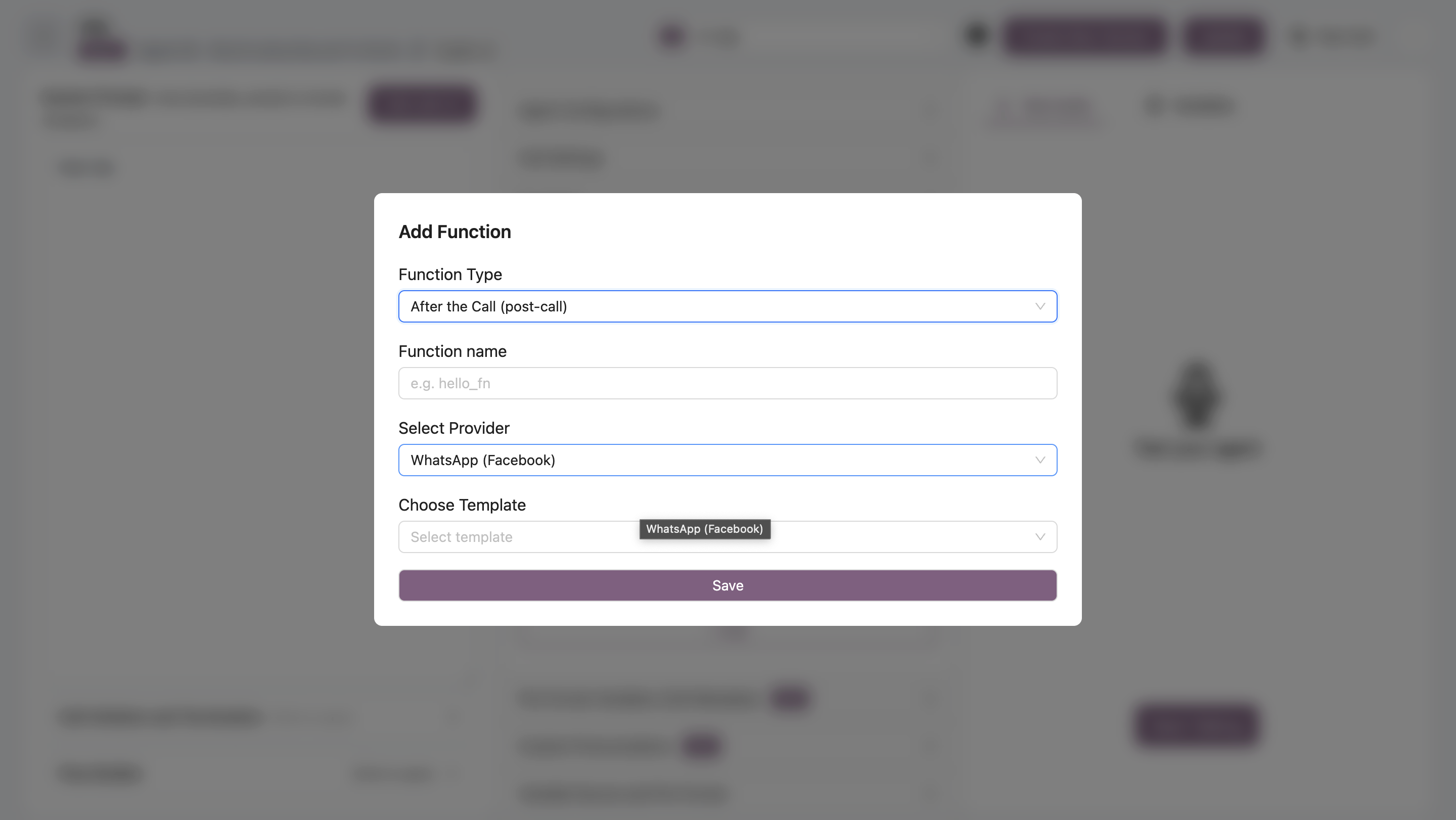 Go to your agent → WhatsApp configuration
Click the Add button to create a new function
Choose "After the Call (post-call)"
Use snake\_case (e.g., `appointment_confirmation`)
Choose WhatsApp provider (Facebook, Heltar, or AI Sensy)
Choose your WhatsApp message template
Connect template placeholders to call data
Define when to send the message
Save the function
## Variable Sources
Post-call functions can use three variable sources:
### 1. Call Metadata
Customer information from your system.
**Example:**
* `customer_name`
* `customer_email`
* `lead_id`
### 2. Post-Call Variables
AI-extracted data from the call conversation.
**Example:**
* `appointment_date` - Date customer selected
* `appointment_time` - Time customer selected
* `interested` - Whether customer showed interest
* `confirmation` - Whether customer confirmed
### 3. Static Values
Fixed text that doesn't change.
**Example:**
* Company name
* Support contact
* Website URL
Detailed guide on mapping template variables
## Conditional Sending
Control when post-call messages send using conditions.
### Call Type Filter
**Options:**
* **All** - Send for all calls (default)
* **Connected** - Only send for connected calls (duration > 0)
* **Not Connected** - Only send for missed/failed calls
### Variable Conditions
Add conditions based on:
* **Call Metadata** - Customer data fields
* **Post-Call Variables** - AI-extracted information
**Logic:** All conditions must match (AND)
**Example Conditions:**
* Call Type: **Connected**
* Post-Call Variable: `appointment_booked` equals `true`
* Call Metadata: `lead_source` equals `"website"`
Complete guide on conditional message sending
## Example: Appointment Confirmation
**Function Name:** `appointment_confirmation`
**Template:** (WhatsApp template with 3 variables)
```
Hi {{1}}, your appointment is confirmed for {{2}} at {{3}}.
We'll see you then!
Reply CANCEL to cancel.
```
**Variable Mapping:**
* `{{1}}` → Call Metadata: `customer_name`
* `{{2}}` → Post-Call Variables: `appointment_date`
* `{{3}}` → Post-Call Variables: `appointment_time`
**Conditions:**
* Call Type: **Connected** (only for successful calls)
* Post-Call Variable: `appointment_booked` equals `true`
**Result:**
Message only sends when:
1. Call was connected (customer answered)
2. AND appointment was actually booked
## Example: Follow-Up Survey
**Function Name:** `satisfaction_survey`
**Template:**
```
Thanks for speaking with us, {{1}}!
Please rate your experience: [Survey Link]
```
**Variable Mapping:**
* `{{1}}` → Call Metadata: `customer_name`
**Conditions:**
* Call Type: **Connected**
* Post-Call Variable: `call_completed` equals `true`
## Provider-Specific Notes
### WhatsApp (Facebook)
* Templates must be **approved** by Meta
* Create in Meta Business Manager
* Only APPROVED templates available
### Heltar
* Templates from Heltar dashboard
* No Meta approval needed
### AI Sensy
**Basic Plan:**
* Enter campaign name manually
* Add variables as needed
**Pro Plan:**
* Select from existing campaigns
* Variables from campaign template
## Best Practices
* **Add conditions** - Don't send to everyone, be selective
* **Connected calls** - Usually filter for connected calls only
* **Verify data** - Ensure post-call variables exist before using
* **Clear templates** - Make messages actionable
* **Add opt-out** - Include unsubscribe option for marketing messages
* **Test conditions** - Verify messages send when expected
Start with simple conditions (connected calls + one variable), then add more as needed.
## Multiple Messages
You can create multiple post-call functions with different conditions:
**Example Setup:**
1. **Booking Confirmation** - Only when `appointment_booked = true`
2. **Not Interested Follow-Up** - Only when `interested = false`
3. **Callback Request** - Only when `callback_requested = true`
Each function sends independently based on its own conditions.
Go to your agent → WhatsApp configuration
Click the Add button to create a new function
Choose "After the Call (post-call)"
Use snake\_case (e.g., `appointment_confirmation`)
Choose WhatsApp provider (Facebook, Heltar, or AI Sensy)
Choose your WhatsApp message template
Connect template placeholders to call data
Define when to send the message
Save the function
## Variable Sources
Post-call functions can use three variable sources:
### 1. Call Metadata
Customer information from your system.
**Example:**
* `customer_name`
* `customer_email`
* `lead_id`
### 2. Post-Call Variables
AI-extracted data from the call conversation.
**Example:**
* `appointment_date` - Date customer selected
* `appointment_time` - Time customer selected
* `interested` - Whether customer showed interest
* `confirmation` - Whether customer confirmed
### 3. Static Values
Fixed text that doesn't change.
**Example:**
* Company name
* Support contact
* Website URL
Detailed guide on mapping template variables
## Conditional Sending
Control when post-call messages send using conditions.
### Call Type Filter
**Options:**
* **All** - Send for all calls (default)
* **Connected** - Only send for connected calls (duration > 0)
* **Not Connected** - Only send for missed/failed calls
### Variable Conditions
Add conditions based on:
* **Call Metadata** - Customer data fields
* **Post-Call Variables** - AI-extracted information
**Logic:** All conditions must match (AND)
**Example Conditions:**
* Call Type: **Connected**
* Post-Call Variable: `appointment_booked` equals `true`
* Call Metadata: `lead_source` equals `"website"`
Complete guide on conditional message sending
## Example: Appointment Confirmation
**Function Name:** `appointment_confirmation`
**Template:** (WhatsApp template with 3 variables)
```
Hi {{1}}, your appointment is confirmed for {{2}} at {{3}}.
We'll see you then!
Reply CANCEL to cancel.
```
**Variable Mapping:**
* `{{1}}` → Call Metadata: `customer_name`
* `{{2}}` → Post-Call Variables: `appointment_date`
* `{{3}}` → Post-Call Variables: `appointment_time`
**Conditions:**
* Call Type: **Connected** (only for successful calls)
* Post-Call Variable: `appointment_booked` equals `true`
**Result:**
Message only sends when:
1. Call was connected (customer answered)
2. AND appointment was actually booked
## Example: Follow-Up Survey
**Function Name:** `satisfaction_survey`
**Template:**
```
Thanks for speaking with us, {{1}}!
Please rate your experience: [Survey Link]
```
**Variable Mapping:**
* `{{1}}` → Call Metadata: `customer_name`
**Conditions:**
* Call Type: **Connected**
* Post-Call Variable: `call_completed` equals `true`
## Provider-Specific Notes
### WhatsApp (Facebook)
* Templates must be **approved** by Meta
* Create in Meta Business Manager
* Only APPROVED templates available
### Heltar
* Templates from Heltar dashboard
* No Meta approval needed
### AI Sensy
**Basic Plan:**
* Enter campaign name manually
* Add variables as needed
**Pro Plan:**
* Select from existing campaigns
* Variables from campaign template
## Best Practices
* **Add conditions** - Don't send to everyone, be selective
* **Connected calls** - Usually filter for connected calls only
* **Verify data** - Ensure post-call variables exist before using
* **Clear templates** - Make messages actionable
* **Add opt-out** - Include unsubscribe option for marketing messages
* **Test conditions** - Verify messages send when expected
Start with simple conditions (connected calls + one variable), then add more as needed.
## Multiple Messages
You can create multiple post-call functions with different conditions:
**Example Setup:**
1. **Booking Confirmation** - Only when `appointment_booked = true`
2. **Not Interested Follow-Up** - Only when `interested = false`
3. **Callback Request** - Only when `callback_requested = true`
Each function sends independently based on its own conditions.